

🧠 Smart Purchasing Suggestions (MRP)
Estimated time: 10 minutes
Level: 🟡 Medium
The brain that decides what to buy for you
🎯 What is MRP?
MRP (Material Requirements Planning) automatically analyzes:
- Your current stock
- Historical consumption
- Pending sales orders
- And decide what to buy, how much and for where
✅ Available Features
Calculation Strategies
Available: ✅ IMPLEMENTED
The system offers four strategies to calculate needs:
| Strategy | Description | Ideal for |
|---|---|---|
| Min/Max | Replenishes to the maximum when it falls below the minimum | Continuous replenishment of standard products |
| Seasonal | Compare with the same period of the previous year | Plan seasons (summer, winter) |
| Moving Average | Average consumption of the last N days | Stable demand with recent trends |
| EOQ (Wilson) | Calculate the optimal quantity minimizing costs | Optimization of order vs. storage costs |
Configurable parameters
| Parameter | Strategies | Description |
|---|---|---|
| Days of coverage | Seasonal, Moving Average | Stock to cover X days |
| Growth factor | All except Min/Max | Ex: 1.10 = +10% vs historical |
| Window (days) | Moving Average | Last N days for calculation |
| Cost per order (EUR) | EOQ | Fixed cost of each order |
| Annual storage rate (%) | EOQ | % of product value |
Seasonal Prediction
Available: ✅ IMPLEMENTED
The system can predict needs based on consumption from the previous year:
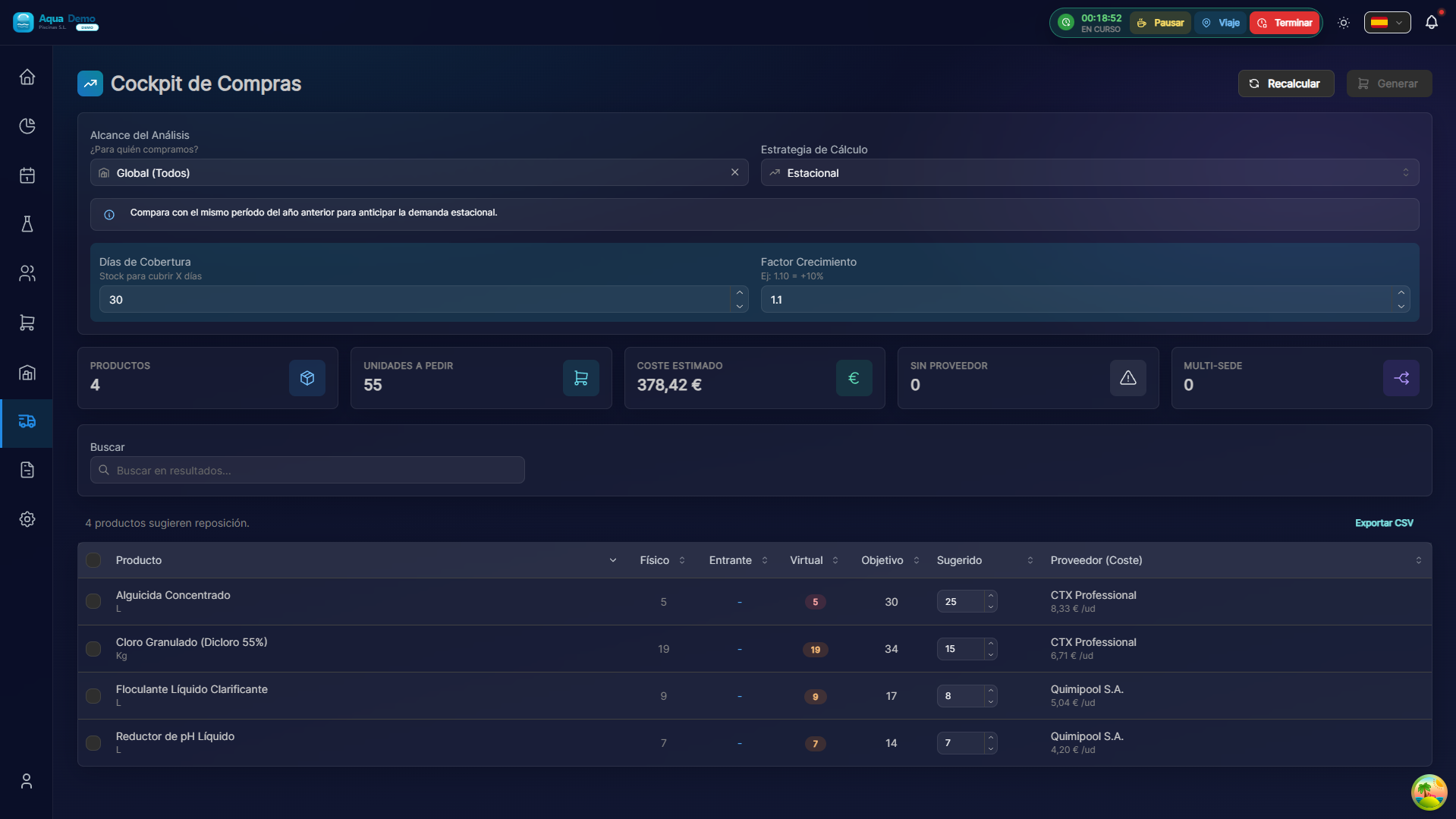
Captura con datos demo AquaDemo.Capture with AquaDemo demo data.
Hub & Spoke (Centralized Distribution)
Available: ✅ IMPLEMENTED
If you have multiple warehouses/delegations:
FLUJO HUB & SPOKE:

1. Análisis Global:
   Almacén Central (Madrid): Necesita 100 unidades
   Delegación Norte (Bilbao): Necesita 50 unidades
   Delegación Sur (Sevilla): Necesita 30 unidades
   ─────────────────────────────────────────────────
   TOTAL A COMPRAR: 180 unidades

2. Pedido al proveedor:
   → Todo va al Almacén Central (Hub)

3. Distribución interna:
   → 50 unidades a Bilbao (Transferencia)
   → 30 unidades a Sevilla (Transferencia)
   → 100 unidades se quedan en Madrid
Aggregation by Provider
The system automatically groups products from the same supplier:
PEDIDO SUGERIDO #1 - Químicos del Mar
├─ Cloro: 75 unidades
├─ pH-: 20 litros
└─ Algicida: 10 litros
   Total: 890€

PEDIDO SUGERIDO #2 - PoolProducts
├─ Limpiafondos: 3 unidades
└─ Mangueras: 5 unidades
   Total: 450€
📊 Data considered by the MRP
| Data | Description | Origin |
|---|---|---|
| Stock On Hand | What you have physically | Current inventory |
| Incoming Stock | What you already ordered and it will arrive | Orders in progress |
| Virtual Stock | On Hand + Incoming | Automatic calculation |
| Demand Forecast | Expected consumption | Historical previous year |
| Reorder Point | Order point | Configured minimum or dynamic calculation |
| Target Stock | Stock target | Maximum configured or desired coverage |
💡 Use Cases
Case 1: Prepare High Season
Situación: Es mayo, se acerca el verano.

Acción:
1. Seleccionar estrategia SEASONAL_FORECAST
2. Configurar 60 días a cubrir (junio-julio)
3. Factor de crecimiento 1.20 (+20% vs año pasado)
4. Ejecutar análisis

Resultado: Lista de compras para toda la temporada
Case 2: Quick Replenishment
Situación: Stock bajo de productos básicos.

Acción:
1. Seleccionar estrategia MIN_MAX
2. Análisis por almacén individual
3. Comprar hasta niveles máximos

Resultado: Reposición óptima sin excesos
Case 3: Order from Sale
Situación: Cliente hace pedido grande de productos.

Acción:
1. Sistema detecta automáticamente (Fulfillment)
2. Si no hay stock suficiente, genera sugerencia
3. Crea pedido de compra vinculado a la venta

Resultado: Compra garantizada para cumplir venta
❓ Frequently Asked Questions
"Does the system buy automatically?"
No. It suggests what to buy, but you review and confirm the order.
"What strategy should I use?"
- Min/Max: For continuous replenishment of standard products
- Seasonal: To plan seasons or products with seasonal variation
- Moving Average: For products with relatively stable demand but you want to base yourself on recent trends (last 90 days by default)
- EOQ (Wilson): To optimize costs when the volume of orders is significant. Calculate the optimal batch that minimizes order + storage costs
"How is seasonal prediction calculated?"
Look at the actual consumption for the same period of the previous year and apply the growth factor you configure.
"What is the EOQ formula?"
EOQ = square root of (2 x Annual Demand x Order Cost / Storage Cost per unit). The system also calculates a reorder point considering the supplier's delivery time and a safety stock.
"Can I modify the suggested quantities?"
Yes, suggestions are editable before generating the final order.
"Does it work for multiple warehouses?"
Yes. You can analyze by individual warehouse or do global analysis with Hub & Spoke distribution.
✅ Usage Checklist
- [ ] Configure minimum/maximum stock of key products
- [ ] Assign default supplier to each product
- [ ] Define strategy according to type of purchase
- [ ] Run scan periodically (weekly/monthly)
- [ ] Review and adjust suggestions before purchasing
- [ ] Generate orders and send to suppliers